NKDA building plan approval is sanction from the New Town Kolkata Development Authority under its Building Rules, 2009. An enlisted architect and engineer apply online through OBPAS. The Rules allow 60 days from a complete application. For residential plots up to 3 cottah, ground coverage can reach 65%.
What are the NKDA building rules?
The New Town Kolkata Development Authority (NKDA) plans and regulates building in New Town, Rajarhat. Building plans there follow the New Town Kolkata Development Authority Act, 2007 and the Building Rules, 2009. NKDA publishes both as a compiled document, which this post reads, accessed on 13 November 2026. Rules are amended from time to time, and NKDA’s circulars carry later changes, so confirm current figures before you design.
Two terms in the Rules matter for every plot:
- Ground coverage is the area of the plot covered by the building at ground level, divided by the total plot area, as a percentage.
- Floor area ratio (FAR) is the total covered area on all floors, excluding the areas the Rules exempt, divided by the plot area.
How do I apply for NKDA plan sanction online?
Application is online only. NKDA’s building department FAQ says a plot owner must engage a registered architect and an enlisted engineer, who prepare the plan, structural design and soil test under the 2009 Rules, and that hard-copy submission is not accepted: you apply through OBPAS.
- Confirm the plot. Check the deed, the mutation record and the plot’s use and road width, because height and open spaces depend on the road.
- Appoint enlisted technical persons. NKDA publishes a list of enrolled technical persons. Section 36A of the Act requires professionals working in New Town to hold a certificate of enlistment, renewed annually.
- Prepare drawings and reports. Architectural, structural and service drawings, with a soil report where the building is tall enough to need one.
- Upload on OBPAS. The professionals submit the application with digitally signed declarations.
- Respond to queries and pay the sanction fee. The sanction is issued once the application is complete and the fee is paid.
- Send the commencement notice. Before work starts, a notice under rule 12(1), Schedule IV, goes to NKDA.
The Rules require the notice at least seven days before work begins, and one set of approved drawings must be kept at the site until the occupancy certificate is issued (rule 12).
What documents does NKDA ask for?
NKDA’s list of documents for a complete application has 17 items. The main ones are in the table below.
| Document | Condition |
|---|---|
| Registered deed of conveyance with site plan | All applications |
| Memorandum of possession | All applications |
| Mutation certificate (Form G) or record of title | All applications |
| Up-to-date property tax | All applications |
| Digitally signed declarations of architect and civil or structural engineer | All applications |
| Geotechnical declaration and soil test report | Buildings 15.1 m high or more |
| NOC from West Bengal Fire and Emergency Services | Residential above 15.1 m, or any non-residential building |
| NOC from the Airport Authority of India | Residential above 15.1 m if not in the height clearance list, or any non-residential building |
| Solar energy declaration | Buildings above 15.5 m |
| Town planner or urban designer declaration | Plots above 2 hectares |
| Plantation plan approved by Forest Department | Built-up area above 20,000 sq m |
The FAQ adds that a pollution control board clearance is needed above 150,000 sq m of built-up area and that the fire safety recommendation also applies to any plot above 1,500 sq m. The boundary wall needs sanction as well. The FAQ gives 1.5 m of masonry from ground level, or 900 mm with wire mesh above, and a solid portion of at most 750 mm at splayed corners.
What are the ground coverage and FAR in New Town?
They depend on plot size and use. Table IV of the Rules gives these maximums.
| Plot size | Residential, educational, institutional: FAR | Ground coverage | Business, assembly: FAR | Ground coverage |
|---|---|---|---|---|
| Below 1,500 sq m | 2.5 | 55% | 2.0 | 45% |
| 4,000 sq m | 2.35 | 50% | 2.0 | 40% |
| 2 hectares | 2.25 | 45% | 2.0 | 40% |
Small residential plots get more. Sub-rule (7)A of rule 22 sets, for residential plots up to 3 cottah or 200 sq m, a maximum ground coverage of 65% and these minimum open spaces:
| Open space | Minimum |
|---|---|
| Front | 0.75 m |
| Rear | 3.0 m |
| Side 1 | 0.9 m |
| Side 2 | 1.2 m |
The Rules add incremental FAR in set cases. Green buildings rated IGBC Gold or GRIHA four star can claim 10% more. Mass housing, hospitals, IT buildings and mega commercial projects can claim 15% more where infrastructure allows, and strips near the metro corridor can claim 15% to 20%. Height is tied to the access road. Table III gives a maximum of 15.1 m where the road is up to 10 m wide.
For what 3 cottah and 5 cottah can hold, see the post on house plans for 2, 3 and 5 cottah plots in Kolkata.
How long does NKDA take, and how long is the sanction valid?
Rule 10 says that within 60 days of receiving an application completed in all respects, the Sanctioning Authority shall accord sanction or reject the application. A rejection does not stop the owner from applying again.
Under rule 11, a sanction is valid for five years and can be renewed for another five on payment of 15% of the building sanction fee. A complete application is the key to speed, since the 60 days run only from the date the file is complete.
How do I get an NKDA occupancy certificate?
The architect and engineer who signed the commencement notice apply on OBPAS. NKDA’s list of documents for an occupancy certificate for small projects (up to G+4) includes:
- The Schedule VII notice of completion.
- The completion plan with all revisions, and the structural drawings.
- Structural stability certificates for the building and the underground reservoir.
- Completion certificates for plumbing and drainage, and for electrical work.
- A lift certificate, where there is a lift.
- The approved service drawings, the mutation certificate, the FAR calculation sheet and car parking statement, and the sanction letter.
Under rule 14, NKDA inspects within 15 days of receiving the completion notice and issues the certificate within one month of the inspection. Bulk projects add a fire safety certificate and a certificate for the transformer and sub-station.
What is the construction site discipline NKDA expects?
The FAQ also covers site conduct. Building material may be stacked on a footpath for six months from commencement, leaving 1.5 m for pedestrians. After that it must stay within the plot, and a fine of ₹50,000 may be charged for breaches. Debris has to be taken to a designated place at the owner’s cost, or NKDA will remove it at ₹2,000 a tonne if informed in advance.
How does a non-residential building in New Town differ?
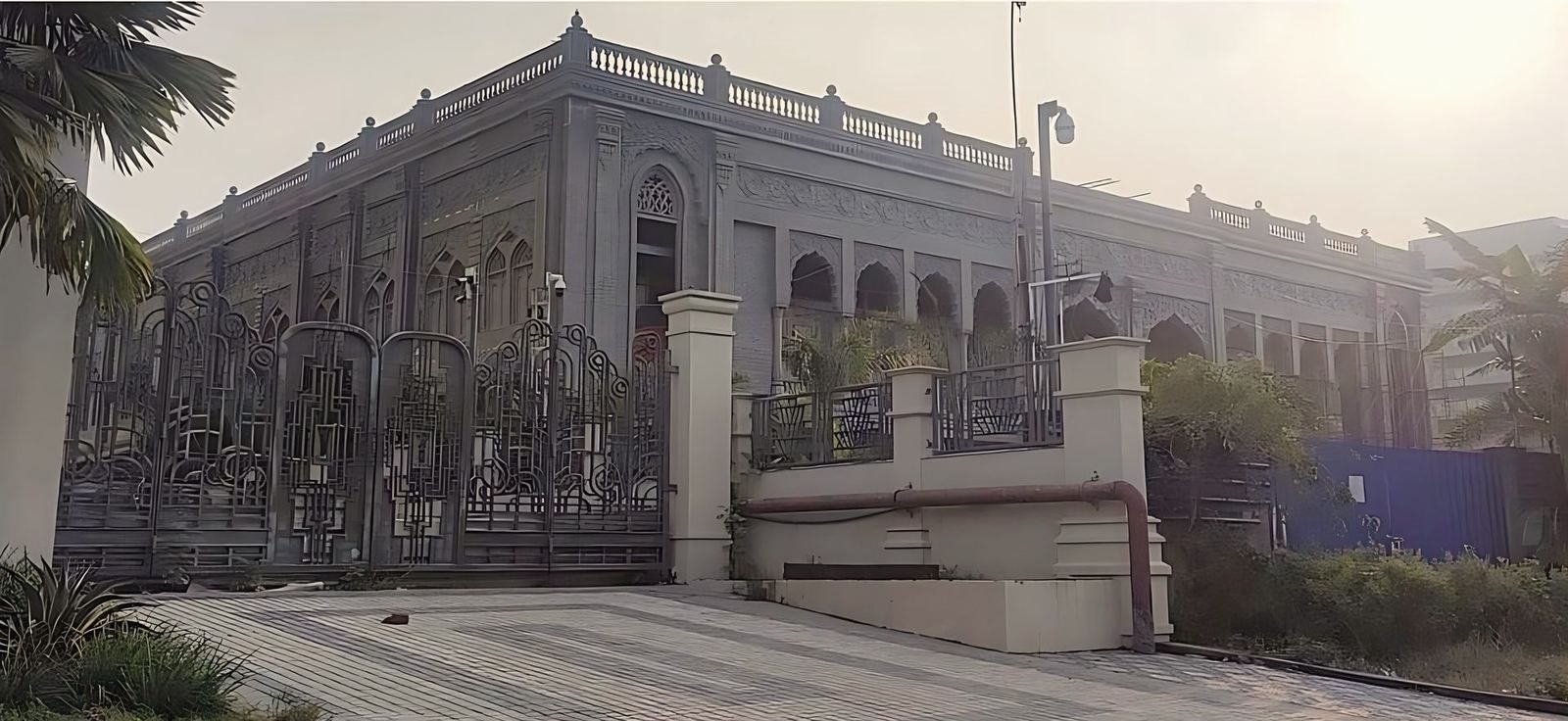
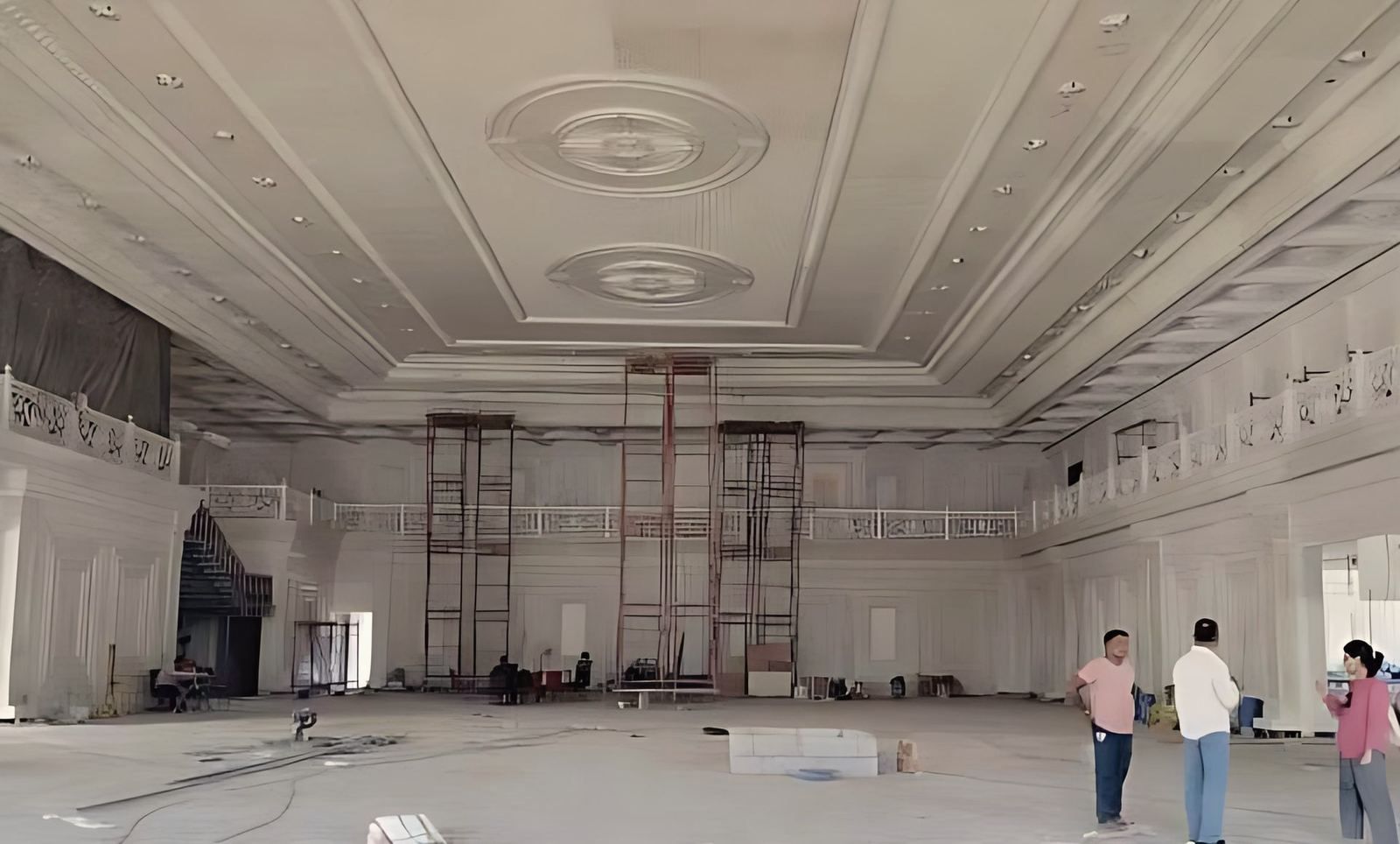
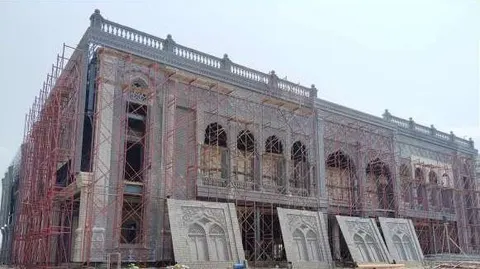
A hall, hotel or office faces more clearances than a house. The studio’s banquet hall in New Town stands on a site of 61,569 sq ft (about 5,720 sq m) and is under construction. For a non-residential building like it, NKDA’s document list requires the fire NOC and the Airport Authority NOC whatever the height. If a hall of that size falls in the business and assembly column of Table IV, the Rules give a maximum FAR of 2.0 and ground coverage of 40%, subject to the sanction.
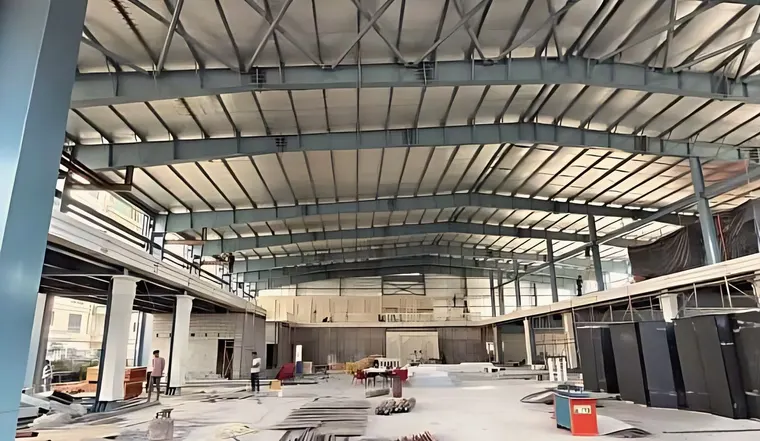
The roof design for a column-free hall is covered in the post on column-free banquet halls, and the fire and licence approvals for such halls in the post on banquet hall design and fire NOC.
What to do next
The studio is empanelled with NKDA and prepares sanction drawings in-house. If you hold a plot in New Town, send the plot number, area and intended use through the contact page. The building plan approval service page lists what the studio prepares for the authority, and the post on KMC building plan sanction covers the corporation’s process for the rest of the city.