Terrazzo is marble or stone chips in a cement or epoxy matrix, ground and polished. Published Indian rates run from about Rs 60 to 300 a sq ft for tiles and Rs 150 to 900 a sq ft installed for in-situ cement and epoxy floors, before GST. Cement terrazzo needs joints and a sealer, and acids etch it.
What is terrazzo, and is it new?
Terrazzo is not new in India. IS 2114 of 1984, the code for in-situ terrazzo, calls it a popular floor finish in residential and public buildings. It is a cement-based floor with marble chips, laid in place, ground and polished. The NTMA says most installations today use an epoxy binder, so the product sold now is often not the cement floor that IS 2114 describes.
Three products share the name:
- In-situ cement terrazzo, laid and polished on site under IS 2114.
- Terrazzo tiles, made in a factory under IS 1237 and laid like any tile.
- Epoxy or resin terrazzo, poured in a thin layer with a non-porous binder.
What does IS 2114 say about in-situ terrazzo?
The 1984 standard sets the build-up of the floor, and its figures are checkable on site:
| Item | IS 2114:1984 |
|---|---|
| Base concrete | At least 100 mm |
| Cushion layer | At least 75 mm |
| Underlayer plus topping, floors | At least 30 mm |
| Underlayer plus topping, skirting and dado | At least 20 mm |
| Topping mix | 3 parts cement to 1 part marble powder by mass, with marble chips of 1 to 25 mm |
| Underlayer | 1:2:4 cement concrete with aggregate not above 10 mm |
The copy read was a scan with some unclear figures, so check a clean copy before writing a specification. The standard handles cracking with dividing strips at least 1.5 mm thick and 25 mm wide, with flooring joints that coincide with structural expansion joints, and with bays laid alternately at least 24 hours apart. It asks for air-curing for 12 to 15 hours and then wet-curing. Grinding follows after at least 2 days by hand or 7 days by machine, through grit grades from 60 and 80 up to 320 to 400, and the surface is finished with oxalic acid and felt.
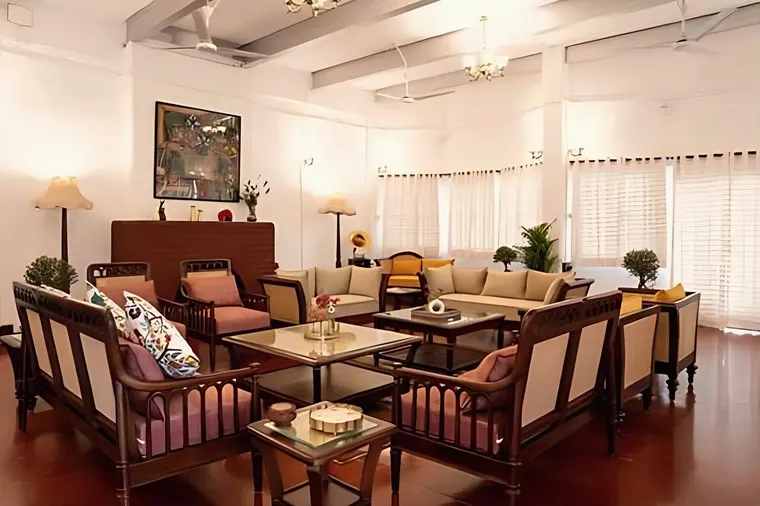
The studio’s Budlapara Tea Retreat keeps the red oxide floors of its 96-year-old bungalow, a coloured floor of an older tradition. The project page does not describe the floor as terrazzo, and the point here is only that floors in old Indian houses were built to be repaired and polished.
What does IS 1237 say about terrazzo tiles?
IS 1237 of 2012 defines a terrazzo tile as one with at least 25 per cent of its wearing surface in stone chips. The wearing layer on a double-layer tile is 5 mm for chips up to 12 mm and 6 mm for chips up to 20 mm. A 300 x 300 mm tile has a minimum thickness of 14 mm in one layer or 20 mm in two layers. Water absorption is at most 10 per cent, wet transverse strength at least 3 N/mm2, and wear at most 3.5 mm for general purpose use. Ask the dealer for the test report against these numbers.
IS 2571, by contrast, covers plain in-situ cement concrete flooring. It is the standard for the plain cement finish and not for terrazzo.
How do cement and epoxy terrazzo differ?
The National Terrazzo and Mosaic Association, a US body, says the majority of installations today are thin-set epoxy and that sand-cushion cement terrazzo is less crack resistant. Sand-cushion cement terrazzo needs an underbed of 2.5 inches, a depressed slab and divider strips every 4 to 5 feet. Epoxy is poured 6 to 12 mm thick, per the Studio Matrx guide, with a divider grid of 0.6 to 1.2 m.
| Feature | Cement terrazzo | Epoxy terrazzo |
|---|---|---|
| Binder | Cement, porous | Epoxy, non-porous |
| Sealer | A penetrating sealer after final polish | Surface sealers only |
| Cracking | More prone, needs joints | Less crack-prone, per NTMA |
| Resealing | Every 1 to 3 years, per Studio Matrx | Less often |
Studio Matrx is a guide site and not a government source, and the NTMA is an American trade body, so the statements describe good practice and not an Indian rule.
What does terrazzo cost?
Three published sources give rates, and they differ in date and in what they cover.
| Source and date | Item | Rate per sq ft |
|---|---|---|
| Studio Matrx, June 2026, before 18 per cent GST | Precast IS 1237 tile | Rs 60 to 200, plus laying Rs 30 to 80 |
| Studio Matrx, June 2026 | In-situ cement, installed | Rs 150 to 450 and above |
| Studio Matrx, June 2026 | Epoxy, installed | Rs 300 to 900 and above |
| Design Cafe, January 2026 | Tiles | Rs 100 to 300, plus installation Rs 30 to 50 |
| Livspace, August 2022 | Tiles | An average of Rs 250 |
A fourth source, BricknBolt, was reported in a search summary as giving Rs 250 to 450 for cement and Rs 400 to 800 for epoxy, but its page could not be read, so that figure is not used. These are published guides, so treat them as a range and ask for quotes in Kolkata, with the thickness, the chip size and the sealer named.
How is terrazzo cleaned?
The advice conflicts. IS 2114 of 1984 says to wash with water and occasionally with a dilute solution of oxalic acid, and says soap shall not be used because it makes the floor slippery. National Concrete and Terrazzo advises neutral cleaners of pH 7 to 10 and says to avoid harmful alkalis and acids. A stone-care supplier says that no penetrating sealer prevents acid etching on cement terrazzo.
For a kitchen floor this matters, since lemon, tamarind and vinegar are acids. Choose epoxy, or tile, or a different floor, if the floor will meet them daily. Ask the installer in writing which cleaner is safe.
When should you choose terrazzo, and when not?
The honest view is that terrazzo is a good floor for the right room and a poor one for the wrong room.
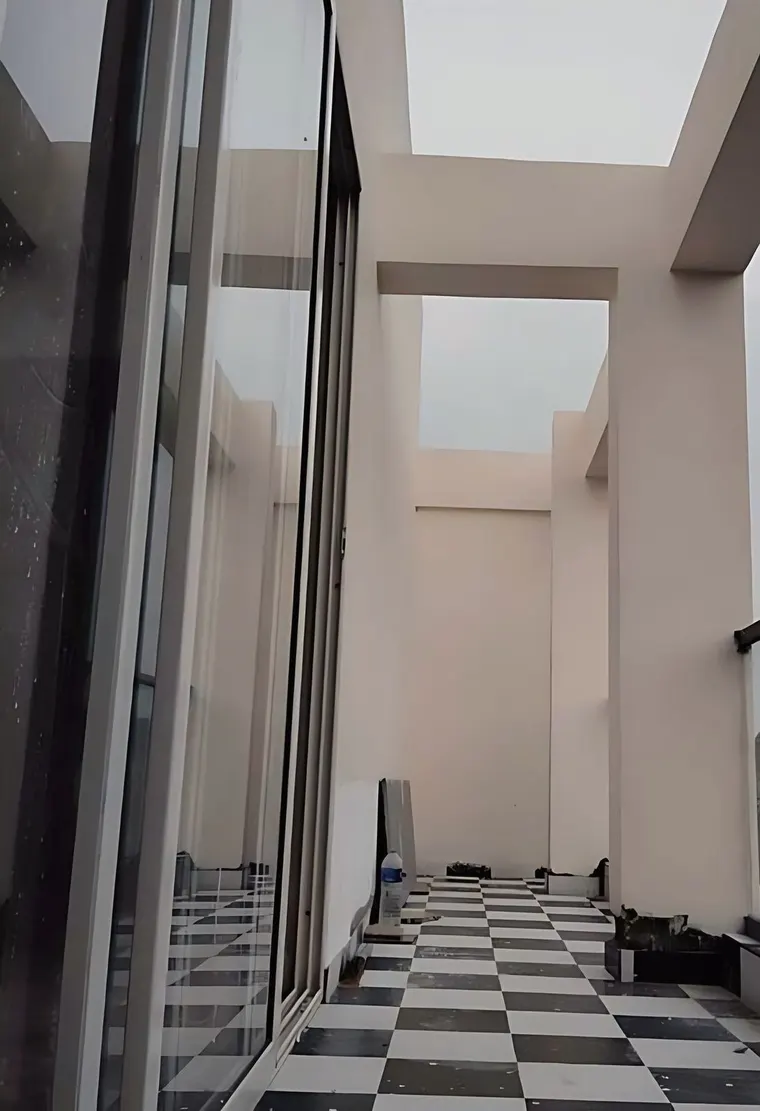
Choose it for living rooms, passages and verandahs, where a hard-wearing floor with few joints is wanted, and where you accept that the floor is repaired by grinding and polishing, not replaced. Choose tiles where speed matters, and in-situ where the floor is large and the contractor has done the work before. Choose epoxy where cracking is the worry.
Avoid cement terrazzo in a kitchen or a bathroom where acids and standing water are common, and avoid it on a slab that moves unless the joints follow the structural joints. Its look is a matter of taste. The guide to interior design trends in Indian homes places it in context.
What next?
Set the floor in the specification with its standard, thickness, chip size, joint plan and sealer. The studio’s interior design service covers floor selection, and the contact page is the way to begin.