West Bengal regularises only minor deviations. A notification of 4 December 2023 defines minor as up to 5 per cent on internal dimensions or covered area and up to 10 per cent on height, with fees of 10 to 80 per cent of the I.G.R. value of the deviated area. Extra floors and larger breaches face demolition.
This is general information from the texts and reports listed below, read on 13 November 2026. Regularisation law is contested in the courts and changes often. It is not legal advice, and an owner with a deviation should consult a lawyer and the authority.
What does the law say about unauthorised construction?
Building without sanction, or against it, is an offence, and the authority can order demolition. The main provisions are:
- KMC Act, 1980, section 400(1): where a building is made without or contrary to the sanction, the Municipal Commissioner may order demolition, giving not less than five and not more than fifteen days. A show-cause notice and a reasonable opportunity come first. Section 400(3) allows an appeal within 30 days to the Municipal Building Tribunal.
- KMC Act, section 401A: a new building or extra floors that endanger human life can bring imprisonment of up to five years and a fine of up to ₹50,000, and the offence is cognizable and non-bailable.
- West Bengal Municipal Act, 1993, section 204: no building without previous sanction. Section 204A has the same five-year and ₹50,000 penalty for endangering construction.
- Section 218 of the 1993 Act: the Board of Councillors, after hearing the owner, may order demolition or alteration of an unlawful building.
- Rule 31 of the 2007 Building Rules: no deviation from a sanctioned plan, except internal alteration within the covered space on 15 days’ notice.
Everything outside minor deviation falls on the demolition side of these provisions. The KMC rules for what needs sanction in the first place are in the post on renovating an old house in Kolkata.
What counts as a minor deviation, and what does it cost?
Notification 889/UDMA-15011(24)/6/2023-LS-MA of 4 December 2023 sets the test and the fees for municipalities other than KMC. Under the 2023 amendment to rule 32 of the 2007 rules, a Board of Councillors may regularise minor unauthorised work or a minor deviation on payment of fees, with regard to listed factors such as road width, drainage, fire clearance, structural safety, the environment and the loss from demolition. The notification says minor means:
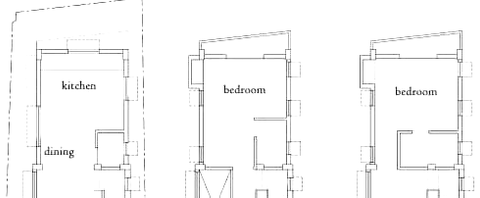
- An internal deviation in sanctioned linear dimensions of up to 5 per cent, without change in the internal arrangement.
- A change in sanctioned covered area of up to 5 per cent, without any new component and without changing the risk category.
- A change in height of up to 10 per cent overall, with no added floor and added height below 3.0 m, within airport limits.
Fees are a percentage of the I.G.R. value, the Registration Department’s valuation of the deviated area:
| Type of deviation | Fee if limits are not exceeded | If maximum permissible limit is exceeded |
|---|---|---|
| Internal dimension | 25% of I.G.R. value | 50% |
| Covered area, up to 80 sq m | 10% | 20% |
| Covered area, above 80 to 130 sq m | 15% | 30% |
| Covered area, above 130 to 200 sq m | 20% | 40% |
| Covered area, above 200 to 300 sq m | 25% | 50% |
| Covered area, above 300 to 800 sq m | 30% | 60% |
| Covered area, above 800 to 1,000 sq m | 35% | 70% |
| Covered area, above 1,000 sq m | 40% | 80% |
| Height, sanctioned height up to 10.0 m | 10% | 20% |
| Height, above 10.0 to 15.5 m | 20% | 40% |
| Height, above 15.5 to 25.5 m | 30% | 60% |
| Height, above 25.5 m | 40% | 80% |
For covered area, “limit” means maximum permissible ground coverage, and for height it means maximum permissible height. Where several minor deviations occur together, the fees add up. The notification also tells municipalities to issue the occupancy, partial occupancy or block-wise occupancy certificate on the engineer’s certification that the work is within the minor limits. The post on completion and occupancy certificates covers that step.
How does KMC regularise a building?
KMC uses the KMC (Regularisation of Building) Regulations, 2015, made under a proviso to section 400(1). In Bikash Kumar Roy v KMC (14 June 2022), the Calcutta High Court quotes clause 4 of the regulations: an unauthorised erection or work may be regularised by the Commissioner or a delegated officer, provided it is determined to be minor, having regard to conditions that include local objections, road width, drainage, fire and pollution clearances, structural safety, the environment and the national loss from demolition. Under clause 5, the officer’s order goes to the Mayor or Mayor-in-Council for concurrence, and the Commissioner then charges fees at the rates in the Budget Schedule. The court held that the Commissioner or the delegated hearing officer has the power to regularise minor deviations on payment of the prescribed fees.
ConstructionWorld reported on 17 March 2022 that KMC required 50 per cent of the calculated retention fee as a deposit before the case went to the special officer for hearing, and that the officer could allow retention or order demolition. The 2015 regulations use the term “minor” without a numeric definition, and a May 2026 report in Hindusthan Samachar says KMC officials want it defined by amendment. The KMC fee schedule was not found for this post, so ask the Building department for the current rates.
In March 2025, The Realty Today reported that KMC would cut the upper limit of the regularisation fee for small plots from ₹3.2 lakh to ₹42,000 and relax open space for plots of 300 to 2,100 sq ft. That report is secondary, and the notified text was not available, so ask KMC before you rely on it. For how open spaces and FAR work in the first place, read FAR and setback rules in Kolkata.
What cannot be regularised, and what have the courts said?
Anything that is not minor, and some things that are, can still be struck down. Three decisions, as reported, set the limits:
- Supreme Court, 17 December 2024 (Rajendra Kumar Barjatya v U.P. Avas Evam Vikas Parishad): The Hitavada reported on 3 January 2025 that unauthorised construction cannot be legitimised merely by administrative delay, passage of time or money invested, and that regularisation schemes should be brought out only in exceptional circumstances, as a one-time measure for residential houses after a detailed survey. This is a national ruling and binds West Bengal authorities.
- Calcutta High Court, July 2025: Millennium Post reported on 29 July 2025 that the court declared void a KMC regularisation of unauthorised floors and uses in a Ballygunge building, made after a completion certificate was issued in 2011, calling it complete disregard of public interest and the environment.
- Supreme Court, 14 October 2024 (Bijay Biswakarma v Rajkumari Devi Singh): reported by SCC Times, the Court let a tenant apply under the 2015 regulations within a month, with the authority to decide within six weeks. The case turned on its facts.
Higher courts have also stressed that a completion certificate does not wash out an earlier violation. Treat regularisation as an exception that needs a fee, a survey and a hearing, not as a plan.
NKDA has its own rules. Rule 13(2)(b) of the New Town Kolkata (Building) Rules, 2009 sets an external deviation fee not exceeding ₹500 per sq m. The post on NKDA building plan approval covers New Town.
What should an owner do about a deviation?
Act before the work is covered, and keep the paper trail. A sensible order:
- Stop further work on the deviating part.
- Get a measured survey and compare it line by line with the sanctioned drawings.
- Sort each difference into internal, covered area, height or something else, and check it against the 5 and 10 per cent limits.
- Ask the structural engineer for a certificate on the affected part.
- Ask the architect or LBS to file with the authority and answer its queries.
- Do not occupy or sell the deviating part until the authority has decided.
The cheaper course is not to deviate. Internal alterations within the sanctioned covered space can go ahead on 15 days’ notice in municipalities and under KMC rule 26(2), and external changes need a revised plan first. The stage checks in the post on site supervision are meant to catch such changes while they cost little.
What to do next
If you hold a building with a deviation, or are planning a change to a sanctioned plan, write down the sanction number, the sanctioned areas and heights, and what has been built, then take them to an architect and a lawyer. The studio’s building plan approval page describes what it prepares for authorities, and the contact page is the place to send the details.